
Squirrel Removal in Toronto
Scampering overhead at first light, a chewed hole at a soffit corner, scratching inside a wall: the most common daytime wildlife noise in a Toronto home, and usually solved from outside it.
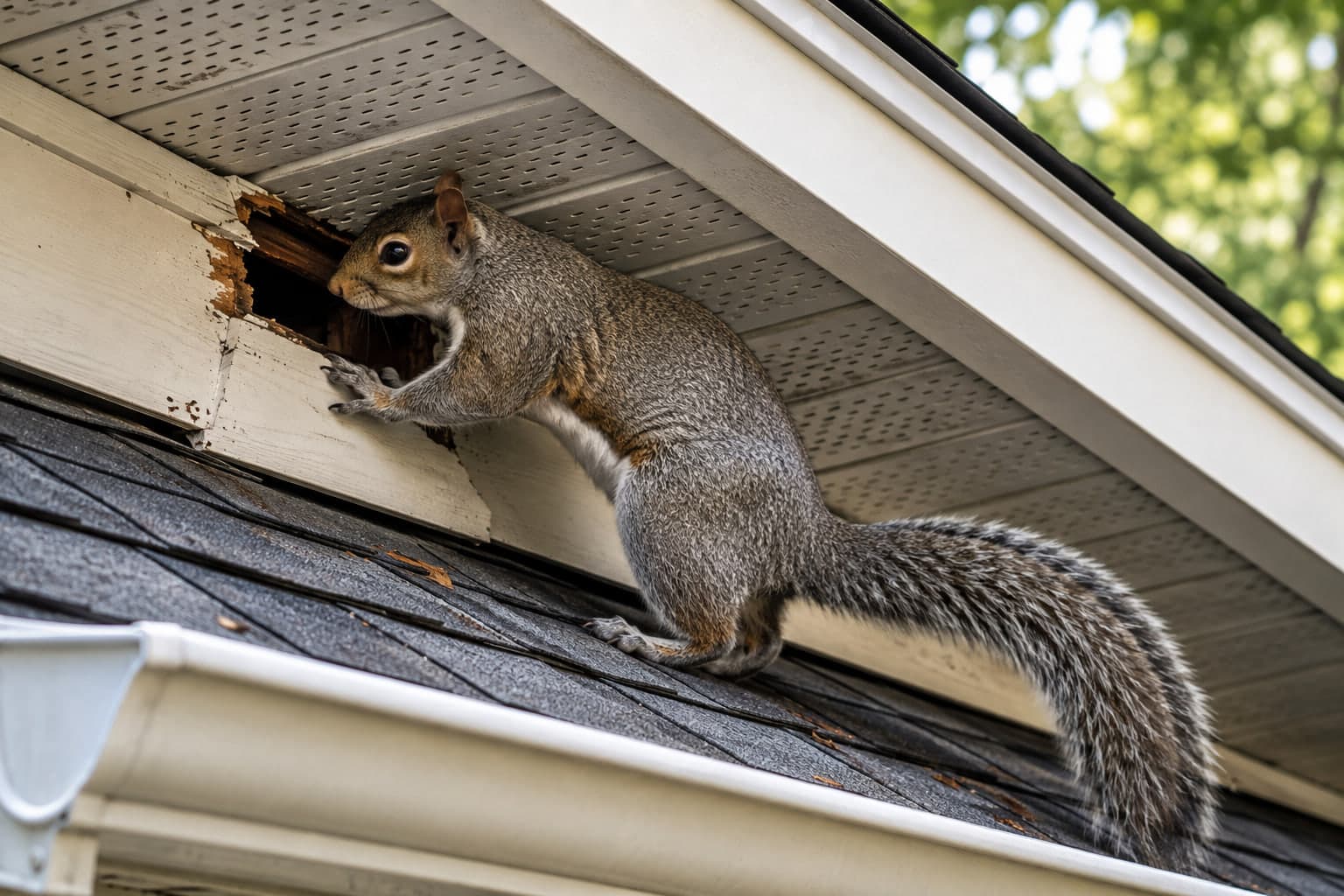
Squirrels can enter through small gaps around soffits, fascia and roof edges. Once inside a soffit or attic, they'll often widen the entry point over time and may return to the same spot even after a first attempt to seal it. Activity is usually most noticeable in early morning and late afternoon.
Lifetime guarantee on every entry point we seal.
$5 million liability insurance
Calls answered 24/7.
Signs of squirrels in your home
Squirrels keep daylight hours, so the noise comes around sunrise and again in the late afternoon, and the hole is often visible from the ground.
- Scratching or scampering along walls or ceilings, mainly during the day
- Gnaw marks on fascia boards, soffits, or wiring
- A visible entry hole at a roofline or soffit corner
- Acorns, twigs, or nesting material collecting in the attic
Squirrels in Toronto
Toronto's squirrels are eastern grey squirrels, and the black ones you see everywhere are the same species in a darker coat. They live in every mature tree in the city, which means every established neighbourhood: the oaks and maples of the Kingsway and Sunnylea along the Humber, York Mills, Hoggs Hollow and Don Mills around the Don, the sixty-year-old trees over the bungalows of Cliffside, Bendale and Wexford in Scarborough, and the street trees of East York and downtown that are as old as the houses.
A branch near the eaves is a bridge, and once a squirrel is on the roof it finds the soft spots: wood fascia that has had decades of weather, a soffit corner that was never quite closed, a plastic roof vent. The pages for Scarborough, North York and Etobicoke go neighbourhood by neighbourhood; the Toronto page covers the whole city.
Two litters a year
Grey squirrels raise young twice a year, once in late winter to early spring and again in late summer, and a warm, dry attic is a favourite nursery. A squirrel you hear in March or in late August is very likely a mother with a nest in the insulation. She moves her babies between dens if she's disturbed, so the noise can stop for a few days and start again, which is not the same as the squirrels being gone.
That is why nothing is sealed until every squirrel, young included, is confirmed out. Close the hole with the babies inside and the mother chews a new one to get back to them; close it with the babies out and the mother in, and she chews her way out, sometimes into the house.
How squirrels get into a house
Squirrels get in by chewing. Wood fascia, aluminum soffit and plastic roof vents all give way to squirrel teeth, and the usual entry points are the roof edge, the soffit corners, gable vents, roof vents and the junction where a roof meets a wall. A small gap is enough to start. They chew it wider over time, and the hole becomes their regular door, used several times a day.
Inside, they nest in the insulation and bring in leaves, twigs and acorns. What makes a squirrel different from a raccoon is that the chewing doesn't stop at the entry point. A squirrel's teeth never stop growing, so it never stops gnawing, and in an attic that sometimes includes wiring, which is the main reason not to leave a squirrel problem until spring.
Why the first patch doesn't hold
A lot of people try one fix themselves first: a board over the hole, some steel wool, a little foam. A squirrel that has been using that hole for weeks comes back to the same spot and chews beside the patch, through it or into a new corner, and if it was inside when the hole was closed, it chews out from the inside.
The fix that holds starts with the whole roofline, because a squirrel that has found one soft spot has usually tested others. Every squirrel is confirmed out, the entry point is sealed, and the chewed wood, soffit or vent is repaired rather than covered over.
A squirrel in the wall or the chimney
Frantic scratching in one spot, at one height, going on for hours, is usually a young squirrel that fell down a wall cavity from the attic and can't climb back out; inside a finished wall there is nothing to grip. This one is urgent, because a stuck squirrel has days, not weeks. Keep pets away from the wall, don't bang on it, and note which wall and roughly how high up. See something in the walls.
A squirrel in the fireplace came down an uncapped chimney and usually can't climb the flue back out. Keep the damper and the fireplace doors closed, keep the room shut, and call. Once it's out, a chimney cap stops the next one.
How we remove squirrels
Usually, we can solve the wildlife problem entirely from outside without needing to enter your home. Here is what a squirrel visit looks like.
- On arrival
- We confirm the squirrel activity and check how it's getting in.
- During the visit
- Removal is handled humanely, with care taken around your roofline and finishes.
- Before we leave
- We'll explain what we found, what we did, and how the animal got in.
A full roofline inspection, to find every chewed spot and not just the one nearest the noise.
We confirm it's squirrels and check for young.
Humane removal from outside. We make sure they're all out, including any young, before anything is sealed.
We seal the entry point. Lifetime guarantee on every entry point we seal.
We repair what they chewed: soffits, fascia boards, roof edges, roof vents, eavestroughs and siding, finished to match the rest of your home.
Same-day service is available for requests received before 4 PM, subject to technician availability. Calls are answered 24 hours a day, 7 days a week.
Sealing & repair
Squirrel removal and roof repair
Squirrels chew. A small gap at a soffit corner or roof edge becomes a hole, and the hole becomes their regular way in and out.
Once we've confirmed the squirrels are out, we seal that spot and repair what they chewed through: soffits, fascia boards, roof edges, roof vents, eavestroughs and siding, finished to match the rest of your home.
Questions about squirrels
Is it a squirrel or a raccoon?
Squirrels keep daylight hours: the noise is light and fast, busiest around sunrise and again in the late afternoon, and quiet at night. Raccoons are the opposite, heavy and slow and after dark. If you're hearing it at 2 AM, it's probably not a squirrel. Either way, you don't need to be sure before you call.
The noise stopped. Are they gone?
Not necessarily. A mother squirrel moves her babies between dens, and squirrels spend the middle of the day out foraging, so a quiet attic for a few days doesn't mean an empty one. The hole is the test: if it's still open, they're still using it.
Do squirrels chew wiring?
Sometimes. A squirrel's teeth never stop growing, so it never stops chewing, and in an attic that can include wiring. That is the main reason not to put a squirrel problem off.
I blocked the hole and they're back. Why?
Because it's their door. A squirrel that has been using an opening for weeks comes back to the same spot and chews beside, through or around the patch, and if a squirrel was inside when the hole was closed, it chews its way out. The fix is to confirm every squirrel is out first, then seal the spot and repair it properly.
What about the babies?
We find where the squirrels are getting in and make sure they're all out, including any young, before anything is sealed. Nothing is closed with a litter still inside.
Will you hurt the squirrels?
No. We use humane removal methods suited to the animal and the situation, and the squirrels leave alive, usually without anyone needing to go inside your home.
How much does squirrel removal cost in Toronto?
It depends on how many ways in there are and what the squirrels chewed. We confirm the price with you once we understand the problem, before any work begins.
Will the squirrels come back?
Not through the opening we sealed. Every entry point we seal comes with a lifetime guarantee, for as long as you own your home. If an animal gets back in through it, we come back and take care of it at no charge. Full terms are written on your invoice.
Are you insured?
Yes. Good Neighbors Wildlife carries $5 million in liability insurance.
How quickly can you get here?
Same-day service is available for requests received before 4 PM, subject to technician availability. The phone is answered 24 hours a day, 7 days a week, and we confirm the timing with you when you call or send a request.


Humane. Local. Same-Day Service.