
Raccoon Removal in Toronto
Heavy footsteps overhead after dark, a torn roof vent, chirping from the attic in spring: the wildlife problem Toronto is famous for, and usually solved from outside your home.
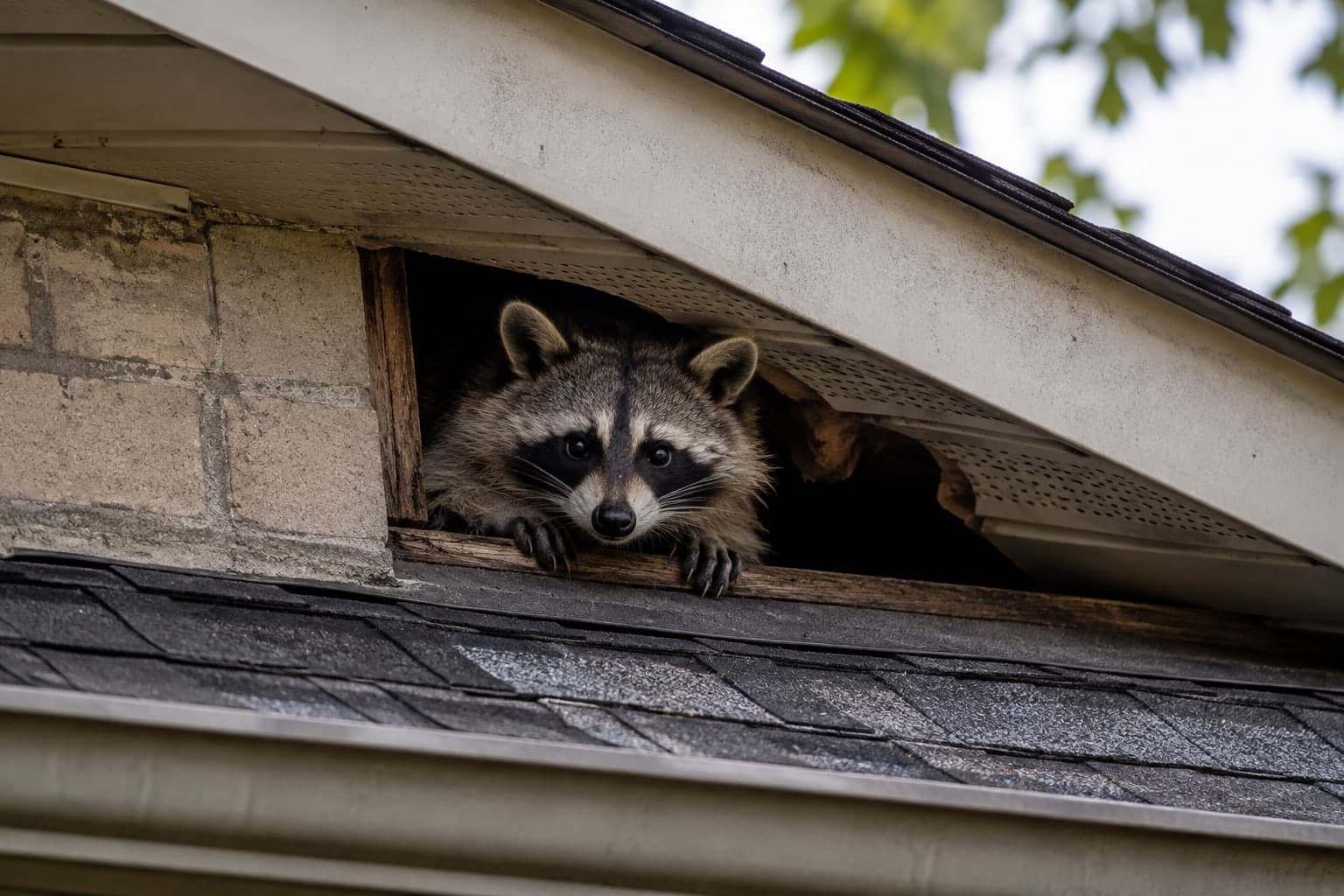
In spring, a female raccoon often looks for a warm, hidden place to raise her young. Raccoons are strong enough to tear rooflines and soffits and clever enough to find the weakest point in a house.
Lifetime guarantee on every entry point we seal.
$5 million liability insurance
Calls answered 24/7.
Signs of a raccoon in your home
Most people never see the raccoon. They hear it after dark, or find the damage outside. You don't need to identify the animal yourself.
- Heavy footsteps or thumping overhead, especially at dusk and dawn
- Torn or lifted roofline, fascia, or soffit
- Flattened insulation or a matted nest area in the attic
- A strong, persistent odor from one area of the attic
Raccoons in Toronto
Toronto has one of the densest urban raccoon populations anywhere, and the reasons are built into the city. The Don, the Humber and the Rouge, and the smaller ravines that feed them, run past the back fences of York Mills and Hoggs Hollow, the Kingsway and Humber Valley Village, Guildwood and the Scarborough Bluffs. Mature oaks and maples reach over the roofs of Don Mills, Sunnylea and Cliffside. And the housing, from the century homes of East York and downtown to the postwar bungalows of Willowdale and Rexdale, has wood soffits, old chimneys and roof vents that have been through sixty or more winters.
A raccoon doesn't need a ravine, though. It needs somewhere dark, dry and quiet, and an attic is exactly that. The raccoon that visits your green bin at night may well be denning a few doors down, and from late winter to early summer a female will be looking for a place to have her kits. Our Toronto page covers the city part by part; Scarborough, North York and Etobicoke each have a page of their own.
Raccoon babies in spring
Raccoon kits are born in spring, mostly in April and May, and they stay with their mother into late summer. A mother raccoon picks a den that is dark, dry and hard to reach: an attic, a chimney, the space between two floors, the ground under a deck or shed. Bird-like chirping or crying from the attic in spring is usually the kits.
This is the most important thing to know before anyone touches the roof. If the opening is closed while the kits are inside, the mother tears at the roof, the soffit or the vent to get back to them, and the kits die inside. Hearing one animal doesn't mean there is one animal. We check for young before removal and take care to avoid separating them from their mother, so the family leaves together.
How raccoons get into a house
Raccoons rarely find a way in. They make one. They climb a downspout, a tree or the corner of the brickwork, then go to work on the weakest point of the roofline: a plastic roof vent pulled right off, a soffit pushed up where the roof meets the eaves, shingles lifted at the edge, a chimney with no cap. On an older Toronto home the trim is wood and gives way quickly; on a newer one, the aluminum soffit lifts at the corners.
Once in, a raccoon settles in. It flattens the insulation into a bed, uses one corner of the attic as a latrine, and comes and goes through the same hole every night. The damage is at the opening, in the insulation, and sometimes in the ceiling below. Our damage repair page lists exactly what we fix.
Why not to wait, and why not to do it yourself
A raccoon in the attic doesn't leave on its own, and the longer it stays the more there is to repair: more soiled insulation, more droppings, a bigger hole. Raccoon droppings can carry raccoon roundworm, so don't handle them, and don't go up to look. Keep pets and children away from the attic hatch and from the spot outside where the raccoon comes and goes.
Sealing the hole yourself is the one thing we'd ask you not to do. A raccoon closed in chews and tears a new way out, sometimes into the house, or it dies in the attic, and a dead raccoon in the insulation means a smell and flies for weeks. A raccoon closed out, with kits still inside, does more damage to the roof than it did getting in. The fix is a full inspection of the roofline, because raccoons often get in far from where you hear them, and a removal done from outside with the young accounted for first.
Raccoons in chimneys, under decks and in sheds
To a raccoon, an uncapped chimney looks like a hollow tree, and the ledge above the fireplace damper is a favourite spot for a mother and her kits. If you hear scratching or chirping from the fireplace, don't light a fire and don't open the damper; keep the room closed and call. Once the raccoons are out, we fit a chimney cap so it doesn't happen again.
Under a deck, a porch or a shed, a raccoon has a dry den with a roof over it. These are solved the same way as an attic: find the animal, make sure any young are accounted for, get the family out, then close off the space it was using. Decks, porches and sheds get wire mesh along the base, dug into the ground, so the next animal that tries meets a barrier instead of an opening.
How we remove raccoons
Usually, we can solve the wildlife problem entirely from outside without needing to enter your home. Here is what a raccoon visit looks like.
- On arrival
- We confirm the raccoon activity and check how it's getting in.
- During the visit
- Removal is handled humanely, with care taken around your roofline and finishes.
- Before we leave
- We'll explain what we found, what we did, and how the animal got in.
A full inspection of the roofline, the chimney and the base of any deck or shed, to find every entry point and not just the one nearest the noise.
We confirm it's a raccoon and check for kits.
Humane removal from outside, with mother and young kept together.
We seal the entry point. Lifetime guarantee on every entry point we seal.
We repair the damage: roof boards and shingles, soffits, fascia, roof vents and chimney caps, plus flattened or soiled attic insulation, matched to your home's existing materials and colours.
Same-day service is available for requests received before 4 PM, subject to technician availability. Calls are answered 24 hours a day, 7 days a week.
Sealing & repair
Raccoon removal and roof damage repair
Raccoons rarely find a way in. They make one. A lifted section of shingles, a torn roof vent or a soffit pried loose is often the first sign one has moved in.
Once the raccoon and any young are out, we seal the opening and repair what it damaged: roof boards and shingles, soffits, fascia and roof vents, matched to your home's existing materials and colours. If the attic insulation has been flattened or soiled, we clean out the droppings and nesting material and replace the insulation too.
Questions about raccoons
How do I know it's a raccoon and not a squirrel?
Go by the clock and the weight of the sound. Raccoons are active at night and sound heavy and slow: footsteps, thumps, sometimes a growl. Squirrels are active in daylight and sound light and fast. Chirping from the attic in spring is usually raccoon kits. You don't need to be sure before you call; our technician confirms it on site.
What should I do right now?
Leave the raccoon alone and don't block the hole. Note where and when you hear it, keep pets away from the attic hatch, and if you can see the opening from the ground, take a photo; you can add up to five to your request. Then call or send a request, and we'll take it from there.
Send a request with photosAre raccoons dangerous?
Raccoons avoid people and will almost always keep their distance. A cornered raccoon, or a mother with kits, will defend herself, so don't try to handle one, and keep pets away from where it comes and goes. Raccoon droppings can carry roundworm, which is why the attic cleanup is part of the job rather than something left to you.
What happens to the raccoon babies?
They leave with their mother. We check for young before removal and take care to avoid separating them from their mother.
Do you remove raccoons from chimneys?
Yes. An uncapped chimney is a common den for a mother raccoon and her kits in spring. Once they're out, we fit a cap or screen so nothing can get back in.
How much does raccoon removal cost in Toronto?
It depends on where the raccoon is, how it got in and what it damaged. We confirm the price with you once we understand the problem, before any work begins.
Will the raccoon come back?
Not through the opening we sealed. Every entry point we seal comes with a lifetime guarantee, for as long as you own your home. If an animal gets back in through it, we come back and take care of it at no charge. Full terms are written on your invoice.
Are you insured?
Yes. Good Neighbors Wildlife carries $5 million in liability insurance.
How quickly can you get here?
Same-day service is available for requests received before 4 PM, subject to technician availability. Calls are answered 24 hours a day, 7 days a week, and we confirm the timing with you before anyone is sent out.


Humane. Local. Same-Day Service.